Stay · São Paulo
Why a first trip to Brazil should start (or end) in São Paulo

Quick take
- On a first visit, fewer destinations done well beat more destinations poorly chained. Brazil does not fit a Europe-by-train calendar.
- São Paulo does not need to be the highlight. It needs to be the start or the finish: Guarulhos is the country’s international hub, and jet lag wants a base, not a layover.
- In 2025 Brazil received 9.3 million foreign tourists. About 2.75 million entered through the state of São Paulo, the main gateway.
- Three honest shapes: 10 days (São Paulo, Iguazu, Rio), 14 days (the same, plus Costa Verde), and 18 to 21 days (Northeast in the middle, Amazon left out).
- Where you sleep at the edges matters as much as Christ the Redeemer: a residential neighborhood, a language you speak, quiet after a 12-hour flight.
The classic first-visit guide to Brazil starts in Rio. Christ, Sugarloaf, beach in the same frame. São Paulo appears, when it appears, as a night lost between connections: a rushed dinner, a generic hotel, an early flight.
It works as a postcard. It works poorly as a trip.
Brazil covers about 8.5 million square kilometers. It is not a country you “do” in ten days. Anyone who tries Rio, Iguazu, Salvador, the Amazon, and the Pantanal in one breath comes home with airports in memory, not the country. The problem is rarely willpower. It is design: the itinerary treats São Paulo as an obstacle, when for most flights from abroad the city is the hinge.
The classic mistake: treating Brazil like a small country
English itineraries that own the search “first time Brazil itinerary” repeat a mold: four nights in Rio, two at Iguazu, maybe Paraty, São Paulo as an asterisk. There are ten-day and fourteen-day versions. Almost all of them open on a beach.
The mold has one merit: Rio delivers the image the visitor already bought. It has one flaw: it ignores how the country is actually flown.
From Foz do Iguaçu to Salvador there is almost no useful nonstop. The standard connection goes through São Paulo. From Manaus to Rio, the same. Guarulhos is not “the city’s airport.” It is the yard where Brazil comes together. Treating that as wasted time is like arriving in London and refusing Heathrow because the photo of the trip is Bath.
There is a second, more human error. After an ocean crossing, the traveler wants to “start already.” They book a domestic flight three hours after the international one. They lose a bag, they lose patience, they reach the second destination already in sleep debt. The first day in Brazil becomes a corridor, a queue, and bad coffee. The city that could have taught the rhythm, the Real, the ride app, actual Portuguese, disappears.
The practical rule is simple: two or three destinations on a first visit, not five. Rio and Iguazu fit. Salvador fits if you have two and a half weeks. The Amazon, the Pantanal, and the whole Northeast do not fit the same first contact unless the trip runs past three weeks and treats long flights as part of the program, not an accident.
Why São Paulo should open or close the itinerary
This is not an argument about taste. It is an argument about flow.
In 2025 Brazil set a record for international tourism: 9,287,196 arrivals, according to the Ministry of Tourism, Embratur, and the Federal Police. The state of São Paulo was the main gateway, with 2,753,869 foreign visitors, 21% more than in 2024, as reported by Agência Brasil. Through São Paulo’s terminals alone, Americans led (431,000), ahead of Argentines, Chileans, Portuguese, and Germans.
The airport that holds that number is Guarulhos (GRU). In 2025 it passed 47 million passengers, the highest volume in Latin America and a record for the concession. In searches for international tickets to Brazil, São Paulo concentrated about 43% of lookups, more than double Rio. Anyone who builds an itinerary “avoiding SP” is, in practice, fighting the network.
That changes the drawing in two ways, and only two:
Start in São Paulo. The long flight ends at GRU. You sleep, have coffee, change money without rushing, try Uber, eat food that is not a “typical folder dish.” On the second or third day you fly to Iguazu or Rio already in the time zone, already with a SIM, already knowing that “obrigado” is said all the time. The city does not need to charm like a postcard. It needs to orient.
End in São Paulo. Rio closes the emotional part. Iguazu closes the landscape. Coming back to the country’s largest city at the end solves what the beginning sometimes does not: shopping that is not a souvenir, a dinner that earns its place, a quiet mattress the night before the ocean crossing, slack if the domestic flight runs late. Anyone who leaves GIG for New York or Lisbon on the same day they came down from Sugarloaf knows the cost: a packed airport, sun, luggage, jet lag in reverse.
Both drawings are honest. What is not honest is a single night in an airport hotel, sold as “São Paulo.” That is not a visit. It is transit.
There is a taste, too, that beach guides underestimate. São Paulo is the Brazil Brazilians live: work, mix, real food, museums, neighborhoods, contradiction. Anyone who only sees Rio on a first trip takes home the right photo and an incomplete idea. Two days in the Paulista capital do not replace Christ. They correct the scale.
Three honest itineraries for a first visit
None of them is “the best of Brazil.” They are the ones that fit a calendar without turning the trip into a connection table. São Paulo appears at the start, at the end, or both, never as a mandatory star in the middle.
Ten days: the triangle (São Paulo, Iguazu, Rio)
The cleanest drawing for short leave.
If the international flight lands at GRU:
- Nights 1 and 2, São Paulo. Arrival, sleep, one full day in the city (Paulista and MASP, a neighborhood to walk, a dinner). Not too many museums. No checklist.
- Nights 3 and 4, Foz do Iguaçu. A flight of about 1h40. One day on the Brazilian side, one on the Argentine side if the passport allows.
- Nights 5 to 9, Rio. Four full days plus arrival slack: Christ, Sugarloaf, a beach, Santa Teresa or Lapa at night, one day with no agenda.
- Exit. International from GIG, or a short hop back to GRU if the ticket is already tied to São Paulo.
If the cheap flight is into Galeão, invert: Rio first, Iguazu in the middle, São Paulo for the last two nights, out through GRU. The content is the same. Only who holds the jet lag changes.
What this itinerary refuses: Paraty, Ilha Grande, Ouro Preto, Salvador. All of that is good. In ten days, it is fat.
Fourteen days: the triangle plus Costa Verde
The same skeleton, with air.
- São Paulo, 2 nights at the start
- Iguazu, 2 nights
- Rio, 4 nights
- Paraty or Ilha Grande, 3 nights (pick one, not both)
- São Paulo, 2 nights at the end
The return to the Paulista capital at the close is not a whim. After an island and a bus, the body wants a stable bed, varied food, and an airport the whole world uses. Anyone who tries to fly home straight from a pier in Angra learns geography the hard way.
Fourteen days still do not fit the Northeast. Salvador from São Paulo is a nonstop of about 2h20. The problem is not arriving. It is leaving there and still wanting Rio and Iguazu without living in transit.
Eighteen to 21 days: the Northeast comes in, the Amazon stays out
- São Paulo, 2 or 3 nights at the start
- Salvador, 3 or 4 nights (Pelourinho with judgment, a museum, a neighborhood beach)
- Coast: Praia do Forte or Porto de Galinhas / Olinda, 3 nights
- Rio, 4 nights
- Iguazu, 2 nights
- São Paulo, 1 or 2 nights at the end, if the exit is GRU
The Amazon waits for the second trip. Manaus is about four hours by air from São Paulo, and a real forest stay wants at least three nights after the airport. Adding that to the classic triangle on a first visit is the most common shortcut to the sentence “I liked it, but it felt rushed.”
Season. December to February is summer, rain in the South and Southeast, high prices, Carnival if the date falls. June to August is a dry winter in São Paulo and at Iguazu (mild cold, good trails) and still beach weather in the Northeast. March to May and September to November are, for most foreign visitors, the best balance of climate and fares.
What almost every guide leaves out about the first and last day
Itineraries publish attractions. Almost none describe day zero.
After 10, 11, 12 hours in the air, the visitor needs four things, in this order: a bed, water, a safe place for the bag, and someone who will explain the obvious in a language they speak. A SIM, PIX, the Real, Uber, “don’t walk staring at your phone on a crowded sidewalk.” A chain hotel on Avenida Paulista solves the room. It rarely solves the rest: the host is an app, the neighborhood at night is an avenue, breakfast is the same as Doha.
There is a 2025 detail older guides still get wrong. Citizens of the United States, Canada, and Australia need an e-Visa again for tourism and business since 10 April 2025. The request is online, on the official VFS portal, and costs US$ 80.90. The European Union, the United Kingdom, and Mercosur remain exempt for short stays. Airlines refuse boarding without the code. Leaving it for the night before is the kind of error GRU will not fix.
On the last day, the criterion flips. The visitor already knows how to order coffee. What they need is slack: a predictable distance to the international airport, a neighborhood that is not a party at 11 p.m., an address the bag can return to after a last lunch. Anyone who sleeps in the Centro “to be close to everything” at the close usually ends up close to noise.
São Paulo at the start teaches the country. São Paulo at the end returns the traveler to the plane in peace. Both roles ask for the same choice of base: not the most photographed hotel, the most livable address.
Where to stay in São Paulo at the edges of the trip
The search “where to stay in São Paulo” pushes Paulista, Jardins, Vila Madalena, sometimes the Centro. Each one solves a kind of day. None should be automatic for someone who just crossed an ocean.
Paulista and Jardins are practical by day: MASP, Faria Lima a short hop, restaurants. At night, avenue. Vila Madalena is charm and bars. The historic center is a city lesson, and it asks for judgment after dark. For the first and last sleep, the better criterion is different:
- A residential neighborhood, not a hotel corridor. A street where people live, bakery commerce, quiet after 10 p.m.
- Time to GRU. A well-connected west side (Perdizes, Pacaembu, Sumaré) is usually 45 to 60 minutes by car, depending on traffic. It is not “under the airport.” It is predictable enough for an international flight.
- Someone on the other end. Language, WhatsApp, “the Uber stops at the gate.” On the first morning in Brazil, that is worth more than a skyline view.
- A piece of real city. A bakery, a square, a neighborhood park. The visitor needs a Brazil that is not performing for them.
Perdizes sits exactly there. It is not a postcard. It is a residential west-side neighborhood, minutes from the metro, Oscar Freire, parks, and axes the visitor already saw on the map. Anyone who wants the big city by day and the calm of a house at night usually understands the neighborhood on the first dusk. A finer map of distances and references is in The Area.
A chain hotel is still right for many people: a meeting, anonymity, miles. The question is whether the first or last night in Brazil wants miles, or an address that feels like a house.
When a residence changes the first and last day
There is a format international itineraries almost never name: a private suite in a real residence, with its own entrance, in a house that is still a house.
It is not a hotel. It is not renting the whole property. It is sleeping in a room of your own, attached to a residence with scale, greenery, water, a place to sit that does not look like a lobby. The host lives there. Speaks the language. Answers the 7 a.m. question (“is Uber Black worth it from GRU?”) without a concierge script.
For a foreigner on day zero, that changes three things.
Jet lag meets a garden, not a corridor. The body that arrived from Frankfurt or Miami needs sky and quiet more than a rooftop.
The city starts filtered. Instead of decoding Paulista at the first coffee, the visitor leaves a neighborhood by Uber, already with a “you don’t need to go far today.” Courage for the rest of the trip grows on the second day, not in the first hour.
The exit stops being a military operation. Bag in the room, a short lunch, a car to Guarulhos with margin. Anyone who has already spent two weeks in Brazil knows the value of a last address that does not charge late check-out in an airport voice.
Staying in a real mansion, in the sense of a residence with scale, not an ad adjective, usually delivers what a flat and an avenue hotel rarely join: nature on the lot, house rooms (a bar, a gourmet kitchen, a garden), and a person on the other side of the conversation. Houses with history and classical architecture carry that in the body. You feel it on the first late afternoon, even without knowing the year it was built. More on this kind of lot and greenery in Nature. On the character of a casarão, in Our Story.
The model is not for anyone who wants zero human contact. A hotel wins that case, no argument.
A concrete reading in Perdizes: Mansão do Lago
If the criteria above ring true, Mansão do Lago is how we receive in Perdizes, including the traveler who is arriving in Brazil or saying goodbye to it.
We offer one private suite on the property, with access entirely from the outside (its own entrance), independent of the family’s indoor circulation. We do not open the whole residence as a hotel. We do not stack rooms.
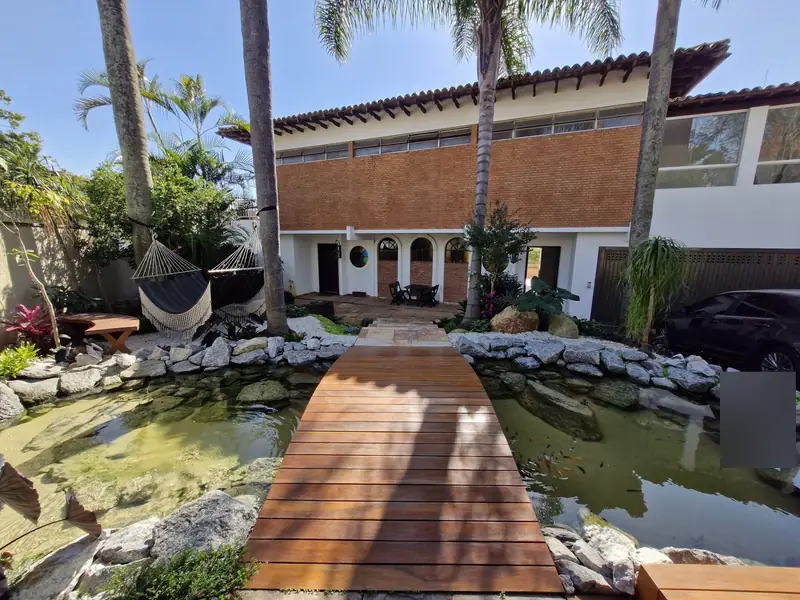
In practice, the stay combines:
- a private suite with exclusive outdoor access (double bed, extra-bed options for up to 5 guests)
- residence leisure: lake with a bridge, pool with a waterfall, gardens, gym, sauna, gourmet area, and the English Pub
- hosts Cintia and Guilherme, in Portuguese, English, and Spanish
Cintia trained in Tourism and has lived abroad. That is not a slogan. On a foreigner’s first day, it is the kind of detail that avoids the wrong coffee, the wrong neighborhood, and the wrong time for GRU.
Why this fits a first-visit itinerary specifically:
- After the ocean crossing. The house is quiet. There is water and green on the lot. The body shuts down better than on an avenue.
- Language and logistics. WhatsApp in English or Spanish, Uber, a SIM, “leave with this margin for the airport.” Guarulhos is about 45 to 55 minutes by car, depending on traffic.
- One suite, not a hostel of strangers. Real privacy, with its own entrance, and shared leisure areas by arrangement. Nobody splits the garden with ten other bookings.
- The city beside you, not on top of you. Sumaré metro, Oscar Freire, neighborhood parks, Paulista a short ride away. The visitor sees São Paulo without sleeping on the avenue.
Images in the Gallery. Dates and rates on the Stay page. House questions in the FAQ.
How to book
We prefer direct booking: it is usually the better rate (from R$ 389 per night, with no platform fees). The suite is also on Airbnb and Booking for anyone who wants the app flow, an international card, and Apple Pay.
Check dates on the Stay page or message us on WhatsApp. Email: [email protected] (WhatsApp is usually faster for dates, and it works well for visitors from abroad).
Book your stay
Best price on direct booking. No platform fees. Hosts in Portuguese, English, and Spanish.
Frequently asked questions
How many days are enough for a first visit to Brazil?
Ten days fit the São Paulo, Iguazu, and Rio triangle. Fourteen days add Paraty or Ilha Grande, not both. Eighteen to 21 days open a Northeast block. The Amazon and the Pantanal are better for a second trip unless you have three weeks and accept long flights as part of the plan.
Is it better to start in Rio or São Paulo?
It depends where the international flight lands. If it is Guarulhos, start in São Paulo: jet lag wants a base, not an immediate connection. If it is Galeão, do Rio first and finish in São Paulo on the way out through GRU. The trip content is the same; what changes is who holds the first and last day.
Do I need a visa to visit Brazil in 2026?
Citizens of the United States, Canada, and Australia need an e-Visa since 10 April 2025, through the official VFS portal, at US$ 80.90. The European Union, the United Kingdom, and Mercosur remain visa-free for short tourist stays. The airline can refuse boarding without the approved code.
Is the Amazon worth adding on a first trip?
On most first-visit calendars, no. Manaus is about four hours by air from São Paulo, and a real forest stay wants at least three nights after the airport. Adding that to Rio and Iguazu on the same first trip usually makes the whole thing feel rushed.
Where should I stay in São Paulo on the first and last night?
Prefer a residential neighborhood, a predictable ride to GRU, and someone who speaks your language. An avenue hotel solves the room; it rarely solves jet lag. In Perdizes, Mansão do Lago offers a private suite with its own entrance, hosts in Portuguese, English, and Spanish, and about 45 to 55 minutes by car to Guarulhos. See Stay.